
All your money
mapped out.
Every account, every bill, every dollar — clearly labeled. No bank connection, no jargon, no advice, just your own money with every number accurately shown.
- Easily upload or enter manually
- All income and spending labeled down to the cent
- Export everything as JSON or CSV. Delete everything in two taps.
Real screens, sample numbers. Nothing is saved.
One-time setup, one-minute update
The simplest way to see where all your money is and where it is going, in three simple steps.
- Step 1
Add your accounts
A nickname, the bank, and the last 4 digits. Leave the balance blank if you do not know it — it will say “balance unknown”, never $0.
- Step 2
Drop in a bank CSV
You choose which column is the date, the description and the amount. Money Map remembers the mapping for that bank and skips duplicates.
- Step 3
See what is coming
Add your repeating bills and paycheck once. The forecast runs your checking balance forward 3, 6, 8 and 12 months — with cents.
Built for a real, non-technical person
Private to your login
Your accounts, balances and transactions are stored on the server for your signed-in account only. No bank login, no full card numbers, no Social Security number.
Plain categories
Groceries, rent, gas, people. Approve a suggested category once and Money Map can file every transaction like it — with one-click undo.
A forecast, not a guess
Two honest lines: bills only, and at your real everyday pace. If the balance crosses $0, you see the date in red.
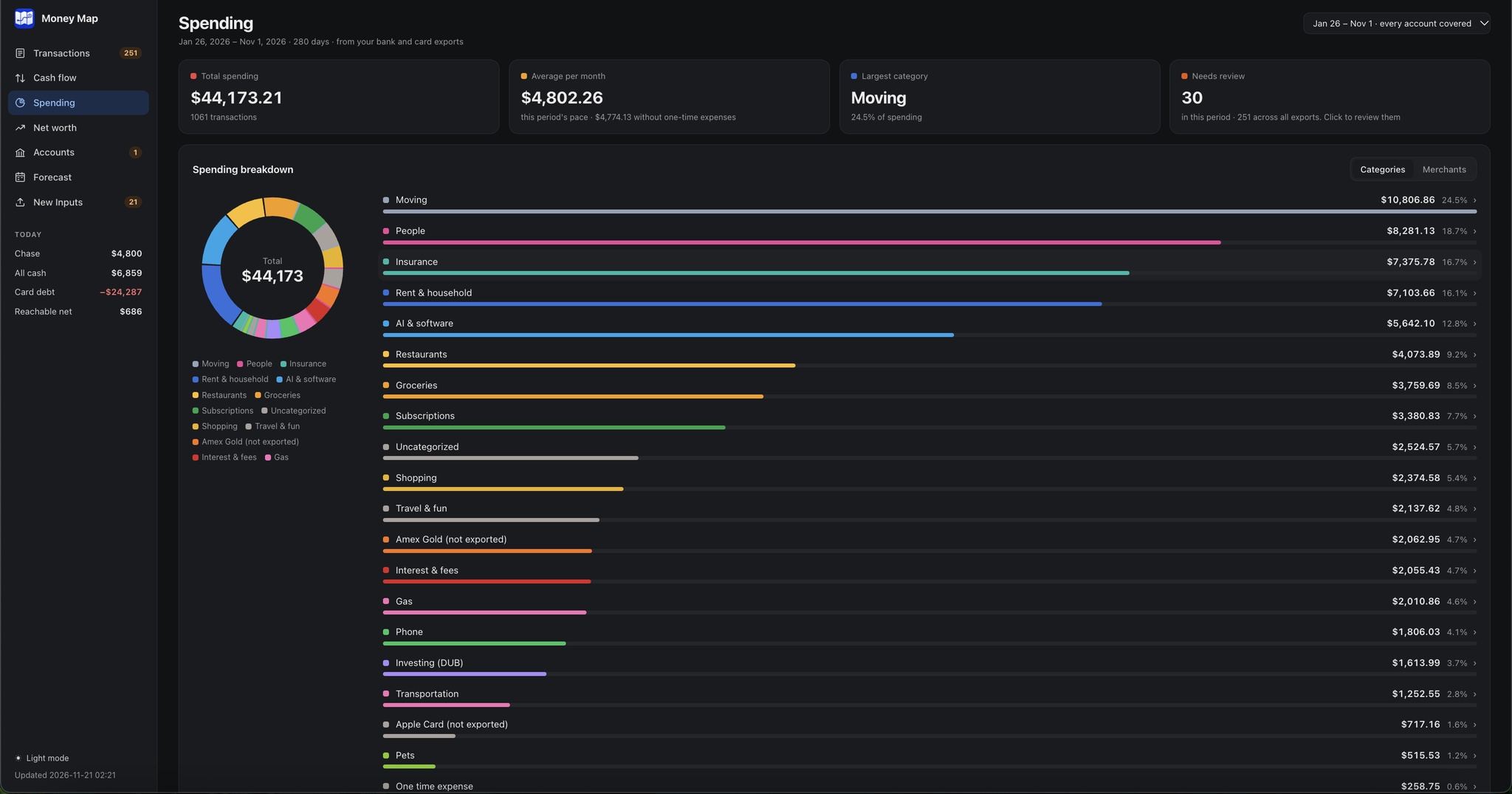
Demo screenshots
Look at the actual screens
Switch between spending, cash flow and net worth.
How the forecast works
Four inputs, two lines, one date.
- 1
Start from today
It begins with the balance you actually have in your main checking account, not an average.
- 2
Add what repeats
Rent, paycheck, phone, subscriptions — amount, frequency and next date.
- 3
Two honest lines
Bills only (best case) and at your current pace, taken from the last 90 days.
- 4
The date it breaks
If the balance crosses $0, you see the exact day and the low point, to the cent.
See how much money you’ll have in eight months
Your real bills and your everyday pace, run forward. The date you would run short is shown in red, down to the cent.
Budgeting has never been easier.
Try the forecastIn eight months
$14,995.96
projected at your current pace
Bills only$30,769.52
At current pace$14,995.96
Lowest point$1,889.73 · Dec 8
What is inside
Daily totals
Cash, card debt, investments, retirement and net worth.
Budgets
A monthly ceiling per category, with over-budget warnings on Home.
Forecast
Bills only versus current pace, with the exact date money runs short.
Bills & income
Repeating items, optional cuts, detected from your own statements.
Accounts
Checking, savings, cards, loans, investments and retirement.
Home screen
Install it once; it opens full-screen with its own icon.
Review
Suggested categories, one-click approval, rules you can undo.
Transactions
CSV import with remembered column mapping and duplicate skipping.
Questions people ask
Is my bank connected?
No. Money Map never connects to a bank. You type balances, upload a CSV, or add a screenshot or PDF statement. It never asks for a bank password, PIN, full card number or Social Security number.
Where does my data live?
On the server, tied to your signed-in account only. Nobody else signed in can see it. You can export everything as JSON or CSV, or delete everything in two steps.
I do not have a CSV. What then?
Add a screenshot or PDF of the statement, or type the few transactions that matter. A bank CSV is optional, not required.
How is the current pace calculated?
From your last 90 days of spending, leaving out transfers, card payments and anything already listed as a recurring item. One-time expenses are also shown separately.
What does bills only mean?
The best case: only the repeating items you listed happen, and nothing else is spent. It is a ceiling, not a prediction.
Does it move money or give advice?
No. It never moves money, pays a bill or recommends an investment. Educational tool, not financial advice.